Showing posts with label chicago. Show all posts

Tuesday, July 15, 2014

Disco Demolition Night At Comiskey Park


On July 12, 1979, a double header at Comiskey Park took place, which has since been called Disco Demolition Night. The White Sox had to forfeit the second game as fans ran all over the field during Disco Demolition Night.

Thursday, July 12, 1979, at Comiskey Park in Chicago, Illinois, during which a crate filled with disco records was blown up on the field. It was held during night half of the Chicago White Sox and the Detroit Tigers double header.

During the climax of the event, rowdy fans surged onto the field, and a near riot ensued. It would ultimately prove to be one of the most notable promotional ideas and one of the most infamous since "Ten Cent Beer Night" in Cleveland in 1974.

Although White Sox owner Bill Veeck took much of the public heat for the fiasco, it was known among baseball people that his son Mike was the actual front office "brains" behind it. As a result, Mike was blacklisted from Major League Baseball for a long time after his father retired.

To this day, the second game of this doubleheader is still the last game forfeited in the American League. The last game to end in this manner in the National League was on August 10, 1995, when a baseball giveaway promotion went awry and resulted in the Los Angeles Dodgers forfeiture.
 Check out the video below of ESPN's coverage of Disco Demolition Night:

Tuesday, April 8, 2014

Toronto Blue Jays Play First Game

On April 7, 1977, the Toronto Blue Jays played their first ever regular season game, the attendance was 44,649 as the Jays took on the Chicago White Sox at Exhibition Stadium.

Exhibition Stadium in 1977 for the Toronto Blue Jays first ever regular season game.

The game was most remembered for the weather, which was cold and snowing at the time of the scheduled first pitch. However, snow would stop and the game would continue as planned.

The Jays would come out as the victor of the American League teams by a final score of 9-5.

The win for the Jays was one of just a few that year as they compiled a 54-107 record that year, 45.5 games behind the division winner Yankees.

Thursday, March 13, 2014

Niagra Upsets Florida A&M


On March 13, 2007, University of Niagra defeats Florida A&M 77-69 in Dayton Ohio, in the tournament opener.
The Niagra Eagles Clif Brown after scoring a bucket in the game against Florida A&M.

The win for Niagra in the NCAA Tournament, albeit a “play-in” game, was the first win for Niagra in the tournament since 1970, so it was a big deal.
The hero on the night for the Eagles was Clif Brown, who helped the team to their 12 straight win, scoring 32 points on the night.
With the win Niagra moved on to play top-seeded Kansas in Chicago just a few days later.
The Eagles would end up falling to the Jay Hawks 107-67, but the Eagles would make history in the process winning the only “play-in” game that season, and getting a chance to make history in the NCAA Tournament.

Wednesday, March 12, 2014

Larry Bird Sets Boston Celtics Scoring Record


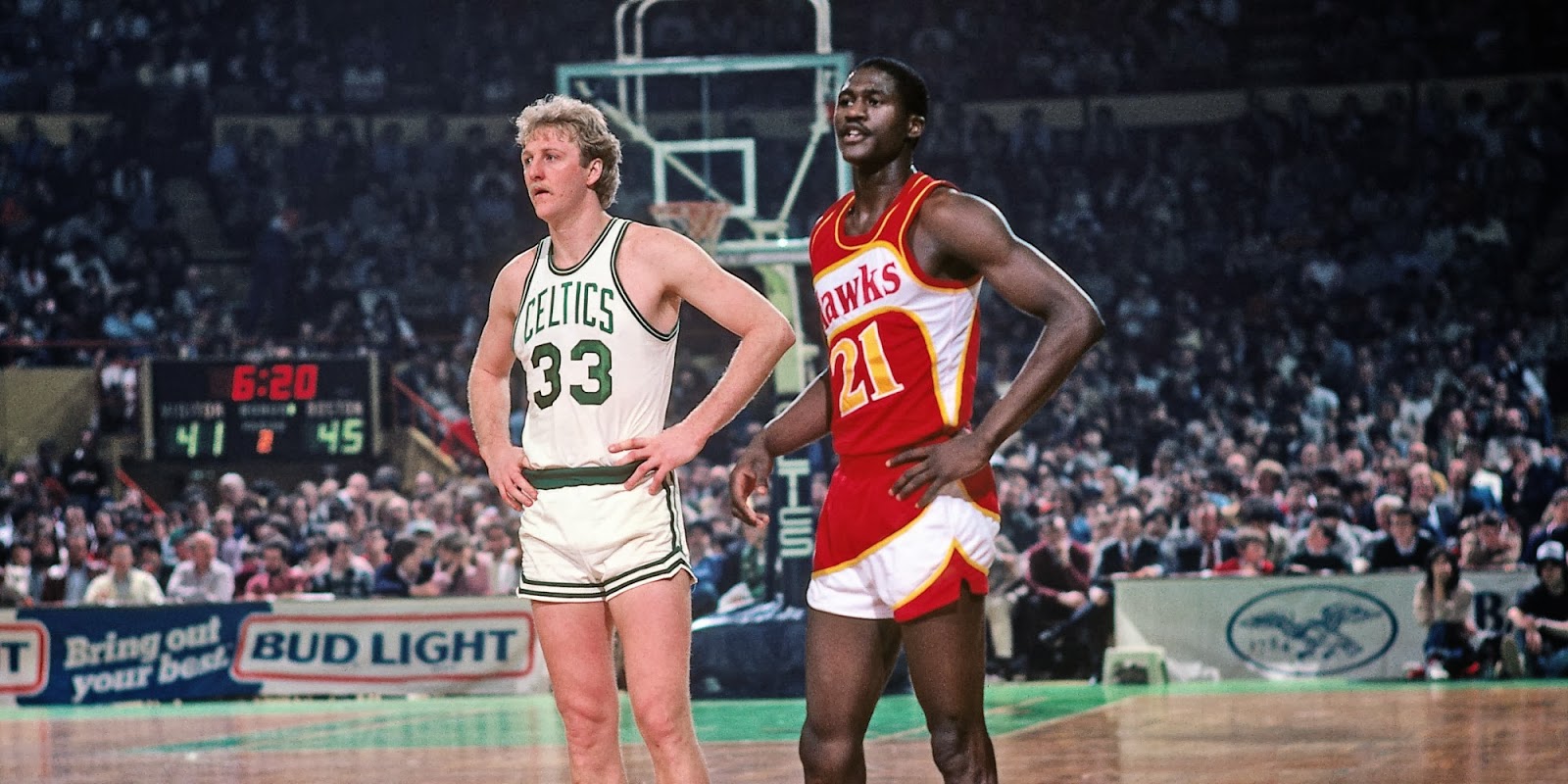
On March 12, 1985,  Larry Bird scores a Boston Celtic record 60 points in a single game.

Boston Celtics great Larry Bird (left) with Atlanta Hawks great Dominque Wilkins (right).


During his career Bird started at small forward and power forward for thirteen seasons, spearheading one of the NBA's most formidable frontcourts that included center Robert Parish and forward Kevin McHale.

Bird was a 12-time NBA All-Star, earning the All-Star Game MVP once, and was named the league's Most Valuable Player (MVP) three times. He played his entire professional career for Boston, winning three NBA championships, and earning the NBA Finals MVP twice.

His other awards included being named to the All-NBA First team nine times, All-NBA second team once, being named to the NBA All-Defensive Second Team three times. He was the NBA Rookie of the Year in 1980 and was nominated to the NBA All-Rookie First Team. He was a three-time Three-point Shootout champion from 1986-1988.

Due to chronic back problems, he retired as a player in 1992. He was a member of the Dream Team that won the gold medal at the 1992 Summer Olympics. Bird was voted to the NBA's 50th Anniversary All-Time Team in 1996 and inducted into the Naismith Memorial Basketball Hall of Fame in 1998.

He served as head coach of the Indiana Pacers from 1997 to 2000. In 2003, he assumed the role of president of basketball operations for the Pacers, and he held that position until 2012. During his tenure as coach with the Pacers, Bird was named the NBA Coach of the Year in 1998 and NBA Executive of the year in 2012.

In addition to being part of the 50–40–90 Club, he is the only person in NBA history to be named Most Valuable Player, Coach of the Year, and Executive of the Year.

During his career Bird scored 21,791 points, averaging 24.3 points per game. He dished out 5,695 assists for an average of 6.3 per game and had 8,974 rebounds, averaging 10 per game over his entire career.

Sunday, February 23, 2014

Chicago Cubs Install Lights


On Feb. 23, 1988, the city of Chicago gives the MLB team the Cubs the right to install lights and play up to 18 night games a season.


The Chicago Cubs were the last team in Major League Baseball to get lights installed to play night games.


Wrigley Field was a holdout against night games, not installing lights until 1988 after baseball officials refused to allow Wrigley to host any post-season games without lights. Before then, all games at Wrigley were played during the day. Night games are still limited in number by agreement with the city council.


In 1942, then-owner P.K. Wrigley had planned to install lights, but instead, the lights and stands were scrapped for the war effort. Though Wrigley was the last Major League ballpark to get its lights, the first night game was scheduled for August 8, 1988; a 91-year-old Harry Grossman flipped a switch and Wrigley Field joined the modern era in a game against the Philadelphia Phillies, but the game was rained out after three and a half innings.

A snapshot of Wrigley Field in Chicago after the lights had been installed in 1988.


The first official night game at Wrigley was held the following day, August 9. The All-American Girls Professional Baseball League's first All-Star Game during the 1943 midseason, was played under temporary lights at Wrigley Field, between two teams composed of South Bend Blue Sox and Rockford Peaches players versus Kenosha Comets and Racine Belles players. It was also the first night game ever played in the historic ballpark (July 1, 1943).


Currently the Cubs are one of only a few teams in baseball that do not have a video board as part of their in-game festivities.


Along with Fenway Park, Wrigley is one of the last parks to maintain a hand-turned scoreboard. Unlike the home of the Red Sox, the scoreboard at Wrigley is mounted above the center field bleachers, rather than at ground level, making it harder to hit during play. No players have hit the current scoreboard, although several have come close. The scoreboard was installed in 1937, when Bill Veeck installed the new bleachers. The scoreboard has remained in place ever since, and has only seen minor modifications. The clock was added in 1941, a fifth row of scores was added to each side in 1961 and later a sixth. A set of light stands facing onto the scoreboard was added in 1988 with the introduction of night games. An electronic message board was also added below the scoreboard.


The scoreboard is still manually operated, with scores coming in through a computer (a ticker tape machine was used in the past); a number turner watches the score changes closely, and updates scores by manually replacing the numbers from within the scoreboard. The scoreboard is made out of sheet steel. The numbers that are placed into the inning windows are steel, painted forest green, and numbered with white numerals. The box for the game playing at Wrigley uses yellow numerals for the current inning. The clock, which sits at the top center of the scoreboard, has never lost time in its 71-year existence. Standing over the clock are three flagpoles, one for each division in the National League. There are 16 flags, one for each National League team, and their order on the flagpoles reflects the current standings. The entrance to the scoreboard is a trap door on the bottom. On the reverse of the scoreboard, visible from the CTA elevated trains, is a blue pennant, with the words "Chicago Cubs", in white outlined in red neon. The scoreboard was extensively rehabilitated for the 2010 season.


In 2010, the Cubs toyed with the idea of adding a video screen to the stadium, but the presence of the hand-turned scoreboard (which cannot be moved due to the park's landmark status, which also prohibits even simple facelifts such as adding two more games on either side 15 teams (seven games on each, plus the one interleague game), respectively, in the leagues; the 12-game, 24-team scoreboard reflects MLB from 1969 to 1976, so up to three games (one NL, one AL, and the inter-league) each day cannot be posted) has hampered efforts to do so. Most Cubs players support the addition of a Jumbotron, but it is unknown whether the team will proceed with plans to add one.


Those games may eventually be part of the auxiliary video board currently on the right field that may also be added in left field also.


The Cubs have not won the World Series in 104 years, the longest championship drought of any major North American professional sports team, and are often referred to as the "Lovable Losers" because of this distinction. They are also known as "The North Siders" because Wrigley Field, their home park since 1916, is located in Chicago's north side Lake View community at 1060 West Addison Street (as opposed to their cross-town rivals, the Chicago White Sox, who play on the city's South Side).


The club played its first games in 1870 as the Chicago White Stockings. This makes the Cubs, along with the Braves who were founded in 1871, one of the two oldest active teams in major North American sports. There is an argument as to whom is actually older because although the Cubs are a full season "older" they lost two seasons to the Great Chicago Fire, thus the Braves have played more seasons.


The Cubs have won two World Series titles in 1907 and 1908. They have won 16 National League pennants, their last being in 1945. They have won two National League Central Division Titles in 2003, 2007 and 2008.


Before the rezoning of teams in the National League the Cubs had won two East Division Titles in 1984 and 1989.


The Cubs have also earned one Wild Card berth in 1998, since the inception of the Wild Card.

Wednesday, November 27, 2013

Williams Sets An NFL Record


On Nov. 27, 1980 Dave Williams of the Chicago Bears becomes the first player in NFL history to return a kickoff for a touchdown in overtime.
Since Williams’ feat in 1980 only seven other over time games have ended with a kick return touchdown.

Wednesday, October 9, 2013

Orioles Sweep Dodgers


On Oct. 9, 1966, the Baltimore Orioles win the World Series as they sweep the Los Angeles Dodgers four games to none. 
The Orioles pitchers threw 33 consecutive scoreless innings, which became a World Series record. The record spanned from the fourth inning in Game 1 through the completion Game 4.
The Baltimore Orioles pitching staff only allowed just two earned runs and finished with a team ERA of 0.50. The two runs scored by the Dodgers in the series were scored in innings two and three of Game 1.

The Orioles became the first non-Yankee American League team to win the World Series since the 1948 Cleveland Indians. The Orioles also became the last of the original eight American League teams to win a World Series at all. 

The Orioles had played in the Fall Classic as the St. Louis Browns in the 1944 World Series, in which they were also the last of the original eight AL teams to participate in a World Series.


Since their first World Series title in 1966 the Baltimore Orioles have won two more World Series titles, in 1970 and 1983 while going to the World Series five more times including three straight appearances from 1969-1971.

Friday, October 4, 2013

Replacement Players In NFL


On Oct. 4, 1987, the NFL has replacement players play for the first time. The replacement players would last three weeks before the regular players would return. Most teams saw record low attendance during the replacement player games.
The 1987 NFL season was the sixty-eighth regular season of the National Football League. A 24-day players' strike reduced the 16-game season to 15. The games that were scheduled for the third week of the season were canceled, but the games for weeks 4–6 were played with replacement players. 85% of the veteran players did not cross picket lines during the strike.
The replacement player teams were given mock names like "Chicago Spare Bears", "San Francisco Phoney Niners", "New Orleans Saint Elsewheres", "Washington ScabSkins", and "Seattle Sea-scabs".
Final television revenues were down by about 20 percent, a smaller drop than the networks had expected. The defending Super Bowl Champion New York Giants went 0–3 in replacement games, ultimately costing them a chance to make the playoffs and repeat their championship.
After the season the St. Louis Cardinals' owners announced they would be leaving Missouri for Tempe, Arizona and become the Phoenix Cardinals for 1988.

The season ended with Super Bowl XXII when the Washington Redskins defeated the Denver Broncos 42-10 in Jack Murphy Stadium in San Diego. The Broncos made their second consecutive Super Bowl appearance while the Redskins were returning for the first time since they advanced to Super Bowl XVIII four seasons earlier.

Cubs Win 116 Games


On Oct. 4, 1906, the Chicago Cubs picked up win 116 of the season against the Pittsburgh Pirates. 

The win moved the Cubs record to 116-36. That still stands as the best winning percentage ever. The Cubs failed to win the World Series, however, as they lost in six games. They would recover to win the World Series in 1907 and 1908.

Since 1906 only one team was reached as many wins as the Cubs, the 2001 Seattle Mariners who won 116 games but lost 46 compared to the 1906 Cubs who only lost 36. The reason for the discrepancy in games is because of the addition of more teams and more games to the regular season.
Since the record-tying performance with 116 wins by the Mariners in 2001, no team has gotten close to breaking the record. The 2004 St. Louis Cardinals have the most wins in the last decade with 105. In 2002 the Oakland Athletics and New York Yankees tied for the leagues best record with 103 wins apiece.

Thursday, October 3, 2013

"Hit Heard Around The World"

On Oct. 3, 1951 New York Giants Bobby Thomson hits a walk-off home run to win the pennant, defeating their cross-town rivals the Brooklyn Dodgers. Thomson’s home run has been named the “Hit heard around the world.”

Despite Thomson’s heroics to win the pennant, the Giants would end up losing the World Series to the New York Yankees in six games.

While best known for his walk-off home run against the Dodgers, Thomson had a great career which saw him play for 15 years with the Giants, Milwaukee Braves, Chicago Cubs, Boston Red Sox and Baltimore Orioles.

Over his career Thomson, nicknamed "The Staten Island Scot," was a three-time All-Star, including back-to-back appearances in 1948-1949. Though never an MVP, Thomson was in the MVP conversation three times over the course of his career, with his highest voting for the MVP Award coming in 1951 when he finished eighth. That year he had career highs in home runs with 32, which was the fifth highest total in the MLB that year, and walks with 73. Thomson also had the fourth highest slugging percentage in MLB.

Thomson put up solid numbers over his career including playing in 1,779 games over 15 seasons. Over those 15 seasons, Thomson had 6,305 at-bats with 1,705 hits, consisting of 1,100 singles, 267 doubles, 74 triples and 264 home runs for a .270 lifetime batting average. Thomson also knocked in 1,026 RBIs, scored 903 runs, totaled 38 stolen bases and walked 559 times, while striking out 804 times.

Thomson led the league in triples once, with 14 in 1952. That was also his highest single season total of triples.

Scottish baseball team, the Edinburgh Diamond Devils, named their home "Bobby Thomson Field.” It was opened by the man himself in 2003 while he was in Scotland to be inducted into the Scottish Sports Hall of Fame.

The UK Chapter of The Society for American Baseball Research (SABR) is named the Bobby Thomson Chapter.

Wednesday, September 11, 2013

Plank Reaches 300


On Sept. 11, 1915, Eddie Plank, playing for the St. Louis Terriers of the Federal League, collects win 300 in his career, making him the first left-hander to reach the 300-mark. 
 In his career, Plank went 326-194 with a 2.35 ERA and won 20 or more games in eight different seasons. One of the winningest lefties to ever play in the major leagues, Plank won as many as 26 games in a season but was the first player to reach 300 wins without leading the league in wins at least one time.
Plank, won 305 games in the American League for the Philadelphia Athletics and the St. Louis Terriers making him that league's winningest left-handed pitcher. He would help the Athletics to World Series titles in 1911, and 1913.
In addition, he was the winningest pitcher left or right-handed in the American league until 1921, when Walter Johnson, who finished his career with 417 wins, surpassed him. Plank is still one of the most winningest pitchers of all-time, he is now ranked no. 13 with his 326 wins. 
He also has the most career shutouts by a left-hander in MLB history with 69. His 69 shutouts also put him in the top five in baseball history for most shutouts, only behind the likes of Johnson, Pete Alexander, Christy Mathewson and Cy Young in that order. 
The next closest left-handed pitcher with shutouts is Warren Spahn with 63; he is sixth on the list for most shutouts all-time. Philadelphia Phillies pitcher Roy Halladay leads all active major league pitchers with 20 shutouts, in 16 seasons.

Tuesday, September 10, 2013

McGwire Has Another 50 Home Run Season

On Sept. 10, 1997, St. Louis Cardinals first baseman Mark McGwire joins Babe as only players to hit 50 home runs in two consecutive years.

McGwire had his first of two back-to-back 50 plus home run seasons in 1996 with the Oakland Athletics as he hit 52 home runs to lead the American League in home runs. In 1997 he started the year with the Athletics, and had hit 34 home runs in 105 games but was traded to the Cardinals, where he finished off another 50 plus home run season, with 58 total. He had hit an amazing 24 home runs in 51 games with the Cardinals down the stretch.

McGwire would go on to collect four consecutive 50 plus home runs seasons as in 1998 with the Cardinals he would hit 70 home runs, and in 1999 again with the Cardinals he would hit 65 home runs.

McGwire is only tied with former Chicago Cubs slugger Sammy Sosa, as Major Leaguers who had four consecutive years of 50 plus home runs.

McGwire finished his career with a .263 career batting average, 1,626 hits, and 1,167 runs, 1,414 RBIs to go along with his 583 home runs. His career on base percentage was .394, his career slugging percentage was .588 and his on base plus slugging was .982.

McGwire was the 1987 American League Rookie of the Year, and was a 12-time All-Star including six-straight appearances twice, from 1987-1992 and from 1995-2000. He was a two-time World Series Champion, once as a player with the Oakland Athletics in 1989 and once as a coach with the St. Louis Cardinals in 2011. He won a Golden Glove at first base with the A’s in 1990 and won three Silver Slugger awards, two with the A’s in 1992 and 1996 and one with the Cardinals in 1998.

McGwire also won the 1992 Home Run Derby and was given the Lou Gehrig Award in 1999.
Also in 1999 McGwire was named to the Major League Baseball All-Century Team.

McGwire also played for Team USA in the Los Angeles Olympics in 1984 helping Team USA earn a Silver medal. McGwire also helped the United States in international play during the Pan American Games and Intercontinental Cup in 1983 helping the USA earn a Bronze and Silver medals respectively.

In 1999, The Sporting News released a list of the 100 Greatest Baseball Players. The list had been compiled during the 1998 season and included statistics through the 1997 season. McGwire was ranked at Number 91.

In 2005, The Sporting News published an update of their list and McGwire had been moved up to Number 84.

However, in the 2007, 2008, 2009, 2010, 2011, 2012, and 2013 balloting for the Baseball Hall of Fame, McGwire failed to attain election receiving 128 of the 545 cast (23.5 percent of the vote) in 2007, 128 of 543 (23.6) in 2008, 118 of 539 (21.9) in 2009, 128 of 539 (23.7) in 2010, 115 of 581 (19.8) in 2011, 112 of 573 (19.5) in 2012, and 96 of 569 (16.9) in 2013.

Currently McGwire is the hitting coach for the Los Angeles Dodgers, after being the hitting coach for the St. Louis Cardinals from 2010-2012.

McGwire had a Hall of Fame career based on his stats and accomplishments but because of his trouble with performance enhancing drugs (PED) his call to the hall might come in to questioning.

Tuesday, September 3, 2013

Cobb Collects His Final Hit; 4,191

On September 3, 1928, Major League Baseball Hall of Famer and Detroit Tigers great Ty Cobb gets career hit 4,191, it would also be his last.

At the time of his retirement he was the hit leader in baseball, but since has been passed by one man, Pete Rose. He and Rose are still the only members of the 4,000 hit-club in MLB history. However, Ichiro Suzuki now has over 4,000 hits if you total his time with in the Japanese Leagues with his time in the MLB.

Cobb, nicknamed "The Georgia Peach," was an American Major League Baseball outfielder. He was born in The Narrows, Georgia, a small rural community of farmers that was not an official city or village at the time.

Cobb spent 22 seasons with the Detroit Tigers, the last six as the team's player-manager, and finished his career with the Philadelphia Athletics. In 1936 Cobb received the most votes of any player on the inaugural Baseball Hall of Fame ballot, receiving 222 out of a possible 226 votes.

At the end of his playing career Cobb was credited with breaking 90 MLB records including 54 career steals of home, still the most of all time, 892 stolen bases, which has since been surpassed by three players including current stolen base champion Oakland Athletics great Rickey Henderson.

Most runs scored with 2,245, which has since been surpassed only by Henderson. Most career hits with 4,191, which has since been surpassed only by Rose.

Cobb finished his career as a one time American League MVP in 1911, the winner of 12 batting titles, including nine in a row from 1907-1915, both of which are the most of all time. He batted over .400 three times, which is tied for an MLB record and only batted under .320 once in his career. He also led the American League with a .350 batting average at age 20, second youngest in MLB history to do so.

Cobb’s career numbers include a .366 batting average, a .433 on-base percentage, a .512 slugging percentage, 4,189 hits, 724 doubles, 295 triples, 117 home runs, 1,249 walks, 1,938 RBIs, 2,246 runs scored, 897 stolen bases in 3,034 games played.

Cobb was named to the Major League Baseball All-Century Team, and Cooperstown Hall of Fame in 1936 with 98.23 percent of the vote. Cobb received the most votes of any player on the inaugural Baseball Hall of Fame ballot, receiving 222 out of a possible 226 votes.

Since the inception of the Major League Baseball Hall of Fame in Cooperstown, New York there have been 300 members elected with only three members with a higher percentage of the vote being inducted after Cobb including in this order of percentage; New York Mets great Tom Seaver 98.84 percent, Texas Rangers, Houston Astros and California Angels great Nolan Ryan 98.79 percent and Baltimore Orioles great Cal Ripken Jr. with 98.53 percent.

Only Kansas City Royals George Brett has topped 98 percent of the vote without surpassing Cobb, with 98.19 percent.

Monday, September 2, 2013

A's Win Streak Reaches 19


On Sep. 2, 2002, the Oakland Athletics wins their nineteenth straight game, which tied an American League record set in 1906 by the Chicago White Sox and again in 1947 by the New York Yankees.
The A’s would go on to win 20 games, an American League record, which still stands today. 
 The winning streak is the fourth longest in Major League history behind only the pair of 21 game winning streaks the Chicago Cubs put together in 1880 and 1935, and the 26 game winning streak the New York Giants put together in 1916.
In 2011, the movie “Moneyball” featuring Brad Pitt as Athletics general manager Billy Beane was filmed at the Coliseum and around Oakland, and was based off the book “Moneyball” and the 20 game win streak the club put together in 2002.

Sunday, September 1, 2013

Seaver Sets A New Strikeout Record

On September 1, 1975, Hall of Famer and New York Mets great Tom Seaver becomes the first pitcher to strike out 200 in eight consecutive seasons.

Seaver would finish his career with 3,640 strikeouts, which at the time was good enough for third all-time being behind only Nolan Ryan and Steve Carlton at the time of his retirement.

The list of current 3000 strikeout pitchers includes in this order from most to least, Nolan Ryan, 5,714, Randy Johnson, 4,875, Roger Clemens, 4,672, Steve Carlton, 4,136, Bert Blyleven, 3,701, Tom Seaver, 3,640, Don Sutton, 3,574, Gaylord Perry, 3,534, Walter Johnson, 3,509, Greg Maddux, 3,371, Phil Niekro, 3,342, Ferguson Jenkins, 3,192, Pedro Martinez, 3,154, Bob Gibson, 3,117, Curt Schilling, 3,116 and John Smoltz, 3,084.

The 3,000-strikeout club might become more elusive as the closest pitcher to the feat is 48-year-old Jamie Moyer. Moyer is the active leader in strikeouts with 2,405 but is currently a free agent after being released by the Toronto Blue Jays AAA affiliate. Because of this Moyer will most likely not reach 3,000, and with the way the game has changed in recent years, one wonders if we will ever see another pitcher join the elusive 3,000 strikeout club.

Seaver had an excellent career that spanned 20-seasons with the New York Mets, Cincinnati Reds, Chicago White Sox and Boston Red Sox, though he primarily known for his time with the Mets.

Seaver’s career numbers include 656 games pitched with 647 starts for a total of 4,783 innings pitched. He put up 311 wins, 205 losses and one save, with 231 complete games and 61 shutouts. He had a 2.86 ERA with 3,640 strikeouts, to just 1,390 walks, allowing just 380 home runs over his career.

Five times Seaver led the league in strikeouts with his highest single season total coming in 1971 with 289. He led the league in ERA three times with his lowest single season ERA coming in 1971 with a 1.76 mark. Seaver also led the league in wins twice with his highest single season total coming in 1969 when he recorded 25 wins.

Seaver, a 12-time All-Star made seven consecutive appearances in the Mid Summer Classic from 1967-1973. He won three Cy Young Awards over his career in 1969, 1973 and 1975. He was a five-time National League Strikeout Champion, including back-to-back awards in 1970-1971, and 1975-1976. Seaver was a three time NL ERA Champion in 1970, 1971 and 1973. He was also a three time NL Wins Champion in 1969, 1975 and 1981. Seaver was also the 1967 Rookie of the Year.

Although he never won an MVP award Seaver was in the conversation 10 times over the course of his career and was on the top 10 in voting five times.

Seaver won the World Series in 1969 with the “Miracle Mets” and pitched a no-hitter on June 16, 1978 against the St. Louis Cardinals.

The Mets retired Seaver’s number 41 jersey in July of 1988.

Seaver was inducted into the Cooperstown Baseball Hall of Fame in 1992 with 98.84 percent of votes, making him the highest vote getter percentage wise ever in baseball history. He is also the only player to wear a New York Mets hat on his plaque in Cooperstown.

Friday, August 30, 2013

Cobb Makes His Debut


On Aug. 30, 1905 Ty Cobb made his major league debut for the Detroit Tigers. Cobb was just 19 years old and played in 41 games in 1905. 

He would retire as the all-time hits leader, with 4,191 hits, now he second behind only Pete Rose. 

He still holds the career record for batting average with .367, in part to such a high batting average was his three seasons of hitting over .400, which is tied for a MLB record. 

But what is more impressive is that he only batted below .320 once. Now if you bat .319 you are awesome, to Cobb that was a poor season.

Cobb also won 12 batting titles, including nine in a row from 1907-1915, he also owns the most batting titles of all time. Cobb also has the most career steals of home, with 54.

Cobb remained with the Tigers until 1926, as he player managed the team from 1921-1926. Cobb played his final two years with the Philadelphia Athletics from 1927-1928.

Cobb was named to the Major League Baseball All-Century Team, and Cooperstown Hall of Fame in 1936 with 98.2 percent of the vote.

Thursday, August 29, 2013

Brett Reaches 1,500 Hits

On August 29, 1982 Hall of Famer and Kansas City Royals great George Brett gets career hit 1,500.

Over his 21 major league seasons, Brett, a lifetime .305 hitter, would go on to collect 3,154 hits, consisting of 665 doubles, 137 triples and 317 home runs. He also had 1,596 RBIs, 1,583 runs scored, 1096 walks and 201 stolen bases.

Three times Brett led the league in hits, with his highest single season total coming in 1976 with 215.
Brett is also one of only four players to hit for a .300 batting average, have 300 or more home runs and have over 3,000 hits in a career. The others include three more Hall of Famers, Hank Aaron, Willie Mays and Stan Musial.

Brett finished his career with 13 All-Star appearances, with 13 consecutive appearances from 1976-1988. He was a three-time Silver Slugger Award winner in 1980, 1985 and 1988. He was a three time American League Batting Champion in 1976, 1980 and 1990. He was a Gold Glove winner in 1985 and that same year he won the World Series with the Royals. On the way to winning the World Series, Brett was named the ALCS MVP.

In 1980 Brett won his only MVP Award, as well the Hutch Award, which is given annually to an active Major League Baseball (MLB) player who "best exemplifies the fighting spirit and competitive desire" of Fred Hutchinson, by persevering through adversity.

In 1986 Brett won the Lou Gehrig Memorial Award, which is given annually to a Major League Baseball (MLB) player who best exhibits the character and integrity of Lou Gehrig, both on the field and off it.

The Kansas City Royals retired his no. 5 jersey in 1994 and in 1999 he was inducted into Cooperstown Baseball Hall of Fame with 98.2 percent of the vote on the first ballot in which he appeared. It was the fourth highest percentage of the vote given to a player ever just behind Cal Ripken Jr., Nolan Ryan, and Tom Seaver.

In 2013 Brett joined the Royals in a different capacity as a hitting coach.

Brock Sets A New Stolen Base Record

On August 29, 1977, Hall of Famer and St. Louis Cardinals great Lou Brock eclipses Ty Cobb's 49-year-old career stolen base record of 892 steals. Brock’s record-breaking performance came as he achieved career stolen base 893 in the loss to the Padres, 4-3.

Brock would go on to steal 938 bases, leaving him as the stolen base leader until Rickey Henderson broke the feat. Currently Brock is still second on the list, more than 300 stolen bases above Juan Pierre who is third on the list with 611.

Brock’s 19-year career with the Chicago Cubs and St. Louis Cardinals saw him play in six All-Star games, including four consecutive appearances from 1971-1975. He was a two-time World Series Champion in 1964 and 1967, both with the St. Louis Cardinals.

Brock won several awards during his career, including the 1967 Babe Ruth Award, given to the player with the best performance in the postseason. The award, created by the New York chapter of the Baseball Writers Association of America (BBWAA) in honor of Babe Ruth, was first awarded in 1949 to the MVP of the World Series, one year after Ruth's death.

The award continued to be awarded exclusively for performances in the World Series until 2007, when the New York chapter of the BBWAA changed the award to cover the entire postseason. Though it precedes the World Series Most Valuable Player Award, which was not created until 1955, the Babe Ruth Award is considered less prestigious, as it is not sanctioned by MLB and is awarded several weeks after the World Series.

Brock also won the 1975 Robert Clemente Award, which is given annually to the Major League Baseball (MLB) player who "best exemplifies the game of baseball, sportsmanship, community involvement and the individual's contribution to his team", as voted on by baseball fans and members of the media. It is named for Hall of Fame outfielder Roberto Clemente. Originally known as the Commissioner's Award, it has been presented by the MLB since 1971. In 1973, the award was renamed after Clemente following his death in a plane crash while delivering supplies to victims of the Nicaragua earthquake.

He also won the 1977 Lou Gehrig Memorial Award, which is given annually to a Major League Baseball (MLB) player who best exhibits the character and integrity of Lou Gehrig, both on the field and off it.

In 1979 Brock won two awards, the National League Comeback Player of the Year award given to the player who has the best season after an injury or dismal season. That same season Brock won the Hutch Award, which is given annually to an active Major League Baseball (MLB) player who "best exemplifies the fighting spirit and competitive desire" of Fred Hutchinson, by persevering through adversity.

Brock finished his career with a .293 batting average, with 3,023 hits, consisting of 486 doubles, 141 triples and 149 home runs. Brock also had 1,610 runs scores, 900 RBIs, and 706 walks in his career to go along with the 938 stolen bases. Eight times Brock led the league in steals with his highest single season total coming in 1974 with 118.

Although never an MVP, Brock was in the MVP conversation 10 times, with his highest finishing rank of second in 1974.

The St. Louis Cardinals retired his no. 20 jersey in 1979, and in 1985 Brock was elected into the Cooperstown Baseball Hall of Fame with 79.75 percent of the vote on the first ballot in which he appeared.

Wednesday, August 28, 2013

Gagne Breaks Consecutive Save Record


On Aug, 28, 2003, Eric Gagne sets a record with consecutive save 44 of the 2003 season, with a total of 52 in a row dating back to the 2002 season.
Gagne would continue his streak into the midst of the 2004 season and eventually earn 84 consecutive saves. By far more than any other closer.
Gagne would finish his career with 187 saves, almost half of those were earned during his streak which last over three consecutive seasons.

Sandberg Notches Back-To-Back 30 Home Run Seasons


On Aug. 28, 1990, Ryne Sandberg of the Chicago Cubs hit home run 30 of the season, which helped the Cubs beat the Houston Astros at the Astrodome.

 It was the second year in a row the future Hall of Famer hit at least 30 home runs, becoming the first major league second baseman to do that. Sandberg wasn't done in 1990 either. He ended up with 40 home runs. After hitting an even 30 in 1989.

Sandberg played 16 years in the major leagues, his first with the Philadelphia Phillies, but as a result of a classic ill-advised trade on the part of Philadelphia, was sent to the Cubs in year two and played the next 15 seasons on the northside of Chicago.


Sandberg was a career .285 hitter, appeared in 10 all-star games, was National League Most Valuable Player in 1984, and elected into the Baseball Hall of Fame in 2005. 
Since Sandberg retired second base has still be a position with limited power but a few players after him have completed the feat.

Jeff Kent hit 30 home runs in three consecutive seasons.

Alfonso Soriano hit 30 home runs in three consecutive seasons.

Chase Utley also hit 30 home runs in three consecutive seasons.

Dan Uggla is the current record holder with five consecutive seasons with 30 or more home runs.